Restoration Notes / 8 min
14/05/2026
The Norton That Nearly Defeated Us
A Commando restoration that turned into a lesson in patience, restraint, and earning the first start.
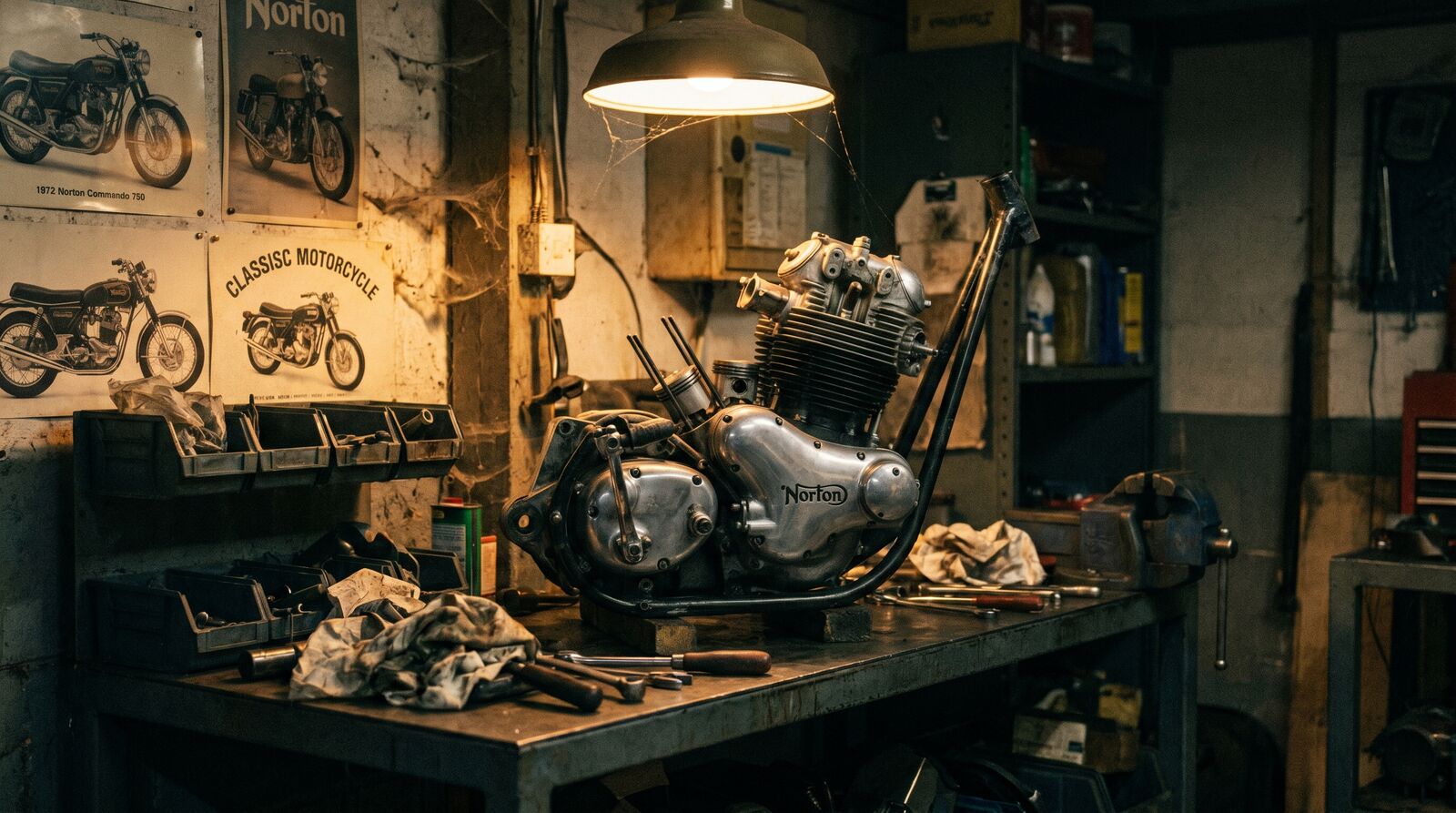
People see a finished motorcycle and assume the hard part was finding the bike. It was not. The hard part was everything that came after.
The bike in question was a 1972 Norton Commando 750 Roadster. When it arrived at our workshop it looked complete from ten feet away, which is usually a warning sign. Motorcycles that appear honest tend to be honest. Motorcycles that look suspiciously complete often hide a lifetime of shortcuts.
The owner had bought it decades earlier and parked it in a dry barn. Dry is a relative term in England. The tank had rust, the wiring had been modified by at least three different people, and every fastener seemed determined to remain where it had spent the last fifty years.
We began as we always do: photographs, notes, measurements, and complete disassembly.
Once the engine came apart the real story emerged. Pistons were worn. Bearings were tired. One previous repair involved a piece of material that definitely did not belong inside a British motorcycle engine. I still have it on a shelf somewhere as a reminder of what enthusiasm can accomplish without patience.
The frame went out for inspection. The wheels were rebuilt from scratch. The forks needed more work than expected. Every stage produced another decision. Restore? Repair? Replace? Preserve?
That is the part nobody talks about. Restoration is not about assembling parts. Restoration is a thousand judgment calls.
You can replace everything and erase history. You can preserve everything and inherit every old problem. The trick is knowing where the motorcycle's character ends and its faults begin.
The Commando taught us patience. Parts arrived late. Components needed remachining. A supposedly correct replacement turned out to be completely wrong. Months passed. Then came the first engine start.
Anyone who restores motorcycles knows that moment. You check oil. You check timing. You check fuel. Then you check everything again.
The engine fired on the third kick. Not because we are geniuses. Because we had spent months eliminating reasons for it not to.
Today it is one of my favorite restorations we have completed. Not because it is perfect, but because it fought us the entire way and forced us to earn the result.